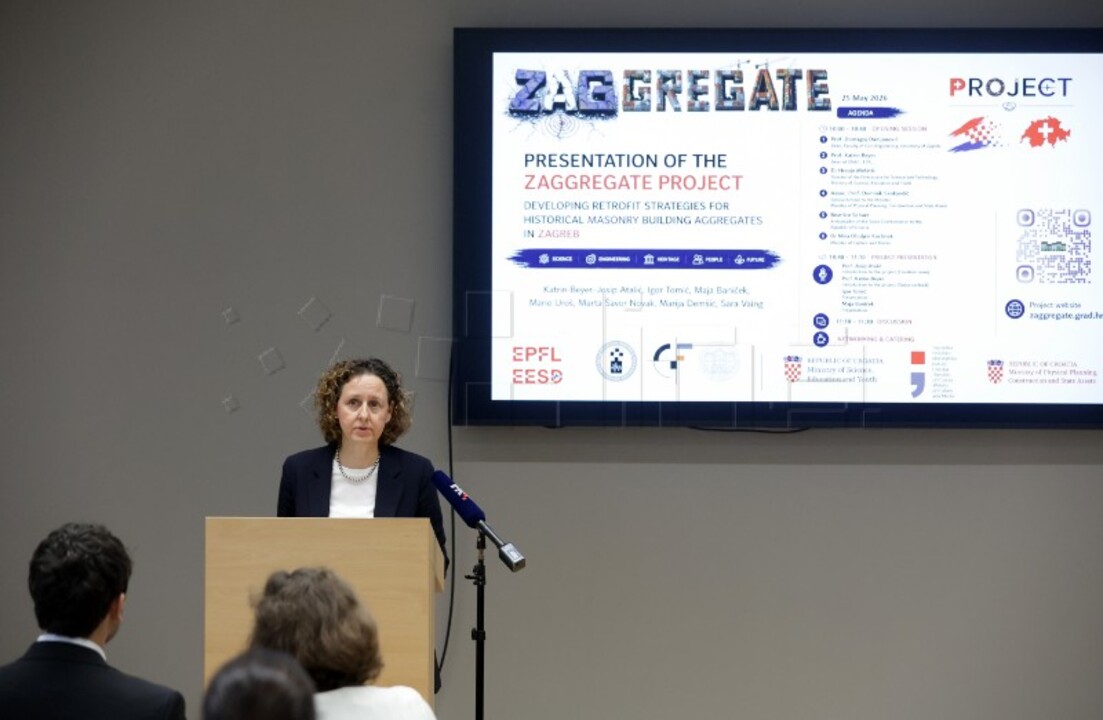
ZAGREB, 26 May (Hina) - A four-year Croatian-Swiss project worth €3 million aimed at strengthening the earthquake resilience of Zagreb’s historic urban blocks was launched at the Faculty of Civil Engineering, following the devastating earthquakes that struck Croatia in 2020.
The ZAGGREGATE project is being jointly implemented by the Faculty of Civil Engineering and the École Polytechnique Fédérale de Lausanne.
Faculty dean Domagoj Damjanović said more than 80% of the funding would be invested in financing new doctoral and postdoctoral positions, with young researchers working alternately in Zagreb and Lausanne.
“The earthquakes were, on the one hand, a great tragedy, and on the other a major opportunity to raise earthquake engineering in Croatia to a higher level,” EPFL researcher Igor Tomić said.
The project includes collecting data on building typologies, experimental research, numerical modelling and the development of reinforcement strategies.
Researchers highlighted a specific problem affecting historic urban blocks, where reinforcing one building in isolation can increase seismic risk for neighbouring structures, an issue existing engineering approaches have not adequately addressed.
They said the project’s findings would be applicable not only to Zagreb but also to other European cities with historic masonry blocks, including Bern, Lausanne, Barcelona and Split.
Faculty of Civil Engineering professor Josip Atalić said Zagreb’s historic centre had already been identified in Croatia’s first national seismic risk assessment in 2014 as the country’s biggest problem area, something confirmed by the 2020 earthquake.
He added that the Ministry of Physical Planning increasingly recognised that blocks of buildings in the historic city centre must be addressed collectively during reconstruction efforts.
Dominik Skokandić, special adviser to the minister of physical planning, construction and state assets, said Croatia had lacked an adequate system when the 2020 earthquake struck, but that such a framework had since been established.
He announced the preparation of new seismic hazard maps and a new law that would prescribe guidelines for responding after natural disasters.
Culture Minister Nina Obuljen Koržinek said the ministry had so far restored more than 500 historic buildings in earthquake-affected areas.
“Our unique experience in the rapid and expert assessment of damage and the restoration of cultural heritage in a way that preserves all its characteristics while making buildings safe and resilient to future disasters is an example we will share with others. No one will be able to carry out such complex reconstruction processes without learning from the Croatian experience,” she said.
She recalled that at the start of the reconstruction process she had established an international advisory panel for the structural restoration of cultural heritage in earthquake-affected areas, whose members included Katrin Beyer, dean of EPFL’s School of Architecture, Civil and Environmental Engineering, laying the foundations for the current cooperation.
Hrvoje Meštrić of the Ministry of Science, Education and Youth said the ministry had secured €2 million from the state budget, while an additional €1 million would be provided by the Unity Through Knowledge Fund.
He added that Croatian investment in research and development had reached a record €1.2 billion in 2024.
Beyer said cooperation between EPFL and the Zagreb Faculty of Civil Engineering had been ongoing since 2020 and described the project as an excellent platform for developing a new generation of experts with international experience and strong practical knowledge.
Swiss Ambassador Beatrice Schaer welcomed the project as an example of how concrete international cooperation can deliver tangible results and highlighted EPFL’s role as one of Europe’s leading institutions in earthquake engineering.
Srđan Baković
Izvršni urednik
Hrvatska izvještajna novinska agencija (HINA)