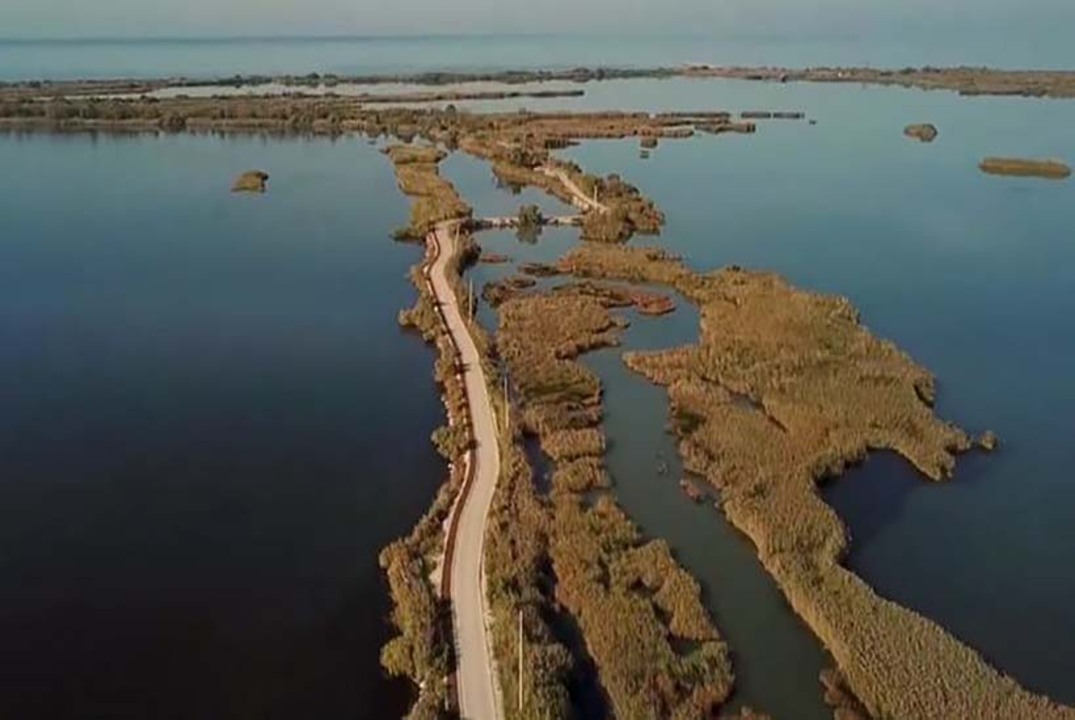
Beja, Portugal, Feb. 9, 2026 (Lusa) - The Portuguese environmental association, Quercus, on Monday accused the government of "mismanagement" of the Alqueva reservoir in the interior Alentejo region of Portugal, arguing that making more water available for irrigation jeopardises the needs of human consumption and industry.
"The Ministry of Agriculture and the Sea has once again given in to the demands of intensive irrigation by rewarding the unregulated expansion of the Alqueva Multi-Purpose Project (EFMA) with an increase in the volume of water available for this activity," Quercus criticised in a statement.
Pointing out that "irrigation will have an additional 100 million cubic metres per year," the environmentalists argued that the ministry led by José Manuel Fernandes devalues "the water needs for urban consumption and industry, which are the sole responsibility of the ministry for the environment and energy."
Quoted in the statement, Quercus president Alexandra Azevedo said that increased water abstraction and the territorial expansion of irrigation will "jeopardise the supply for human consumption, especially in future situations of severe drought, a phenomenon increasingly recorded in Portugal".
According to the environmental association, the government decided, through an interministerial order, to increase the annual volume of water to be extracted from Alqueva by 110 million cubic metres, but of this, "100 million will be allocated to irrigation and only 10 million to urban and industrial consumption".
"This ignores the Water Law, which defines water for human consumption as a priority, essential for keeping people in these regions," it stressed.
Quercus noted that currently, "95% of the water collected in the EFMA (Alqueva Multi-Purpose Project) is for private economic activity, mainly for the expansion of irrigation," with a strategy "focused on export rather than self-consumption" in the domestic market.
This situation causes "damage and the inevitable death of the land and the destructive transformation of the landscape, a heritage that urgently needs to be safeguarded and which is part of our national and regional identity, demonstrating that the priority is profit and not sustainable development," Quercus president Alexandra Azevedo stressed.
In the statement, environmentalists question whether Alqueva's water distribution decisions should not be subject to environmental and economic-financial impact studies and studies of human consumption and industrial development needs in the region.
Another question raised is: "Shouldn't the price of water take into account factors such as the destination of production (export or domestic consumption), the environmental sustainability of crops and the abundance or scarcity of water resources?"
Alluding to the government's "Water that Unites" strategy, Quercus reaffirmed that "water only unites when no one wants to capture it for purposes that aim solely at the profit of a few and the misfortune of many, because those who should have defended the public interest and sustainable development did not do so".
Last week, the environmental association Zero also criticised this decision by the Government, accusing it of ending "the resilience of Alqueva as a strategic water reserve" and rewarding "poor irrigation management".
The Government recently approved a new strategic framework for the management of the project, which increases the volume of water available for agriculture, public supply and industry.
SM/AYLS // AYLS
Lusa