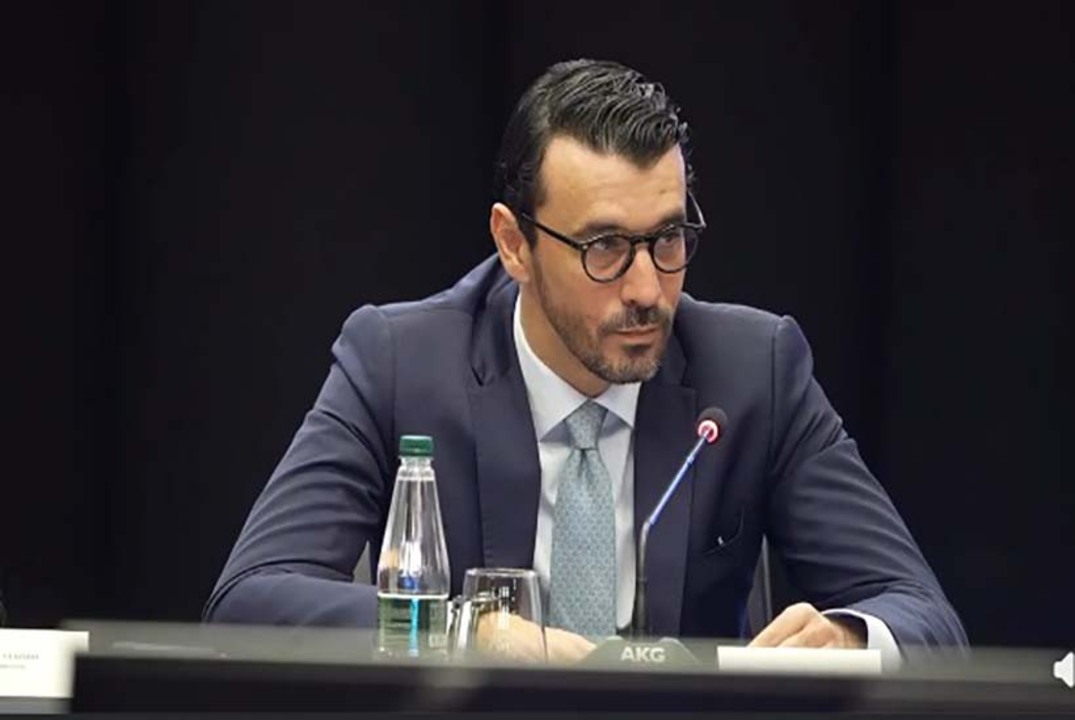
Split, Croatia, Oct. 7, 2026 (Lusa) - Prime Minister Luís Montenegro insisted on Wednesday that he considers it essential to «reflect» on the mechanism for setting oil prices, expressing surprise that this «obvious» issue has received little attention and could help bring down fuel prices.
Speaking on his arrival at a summit of southern European Union (EU) countries in the Croatian city of Split, which has on its agenda a discussion on «the uncertain geopolitical and geo-economic prospects of the Middle East», the head of government, while acknowledging that «a concrete solution» is «very complex and difficult to achieve», once again called for joint reflection.
«As I have already had occasion to say at the United Nations General Assembly […], we need to launch a discussion on issues relating to energy security, the safeguarding of supply chains, the energy transition, which is, from a European perspective, I would say, the overarching objective, the electrification of our economy, the utilisation of our production capacity where we have the greatest potential, and that is clearly in the field of renewable energy,» he began by saying.
«But at the same time, there is one thing that seems obvious to me, which I see few people still talking about, but which I believe is very important,» he continued, referring to the «mechanism that was established following the last major fuel crisis in the [19]70s».
According to the prime minister, «it is a mechanism that undoubtedly has its merits, but which today, in light of current events, presents a significant challenge, namely that a disruption in a particular region, even if it is significant in terms of global production, leads to a price change across the whole world».
«Take the case of Portugal: we buy oil mainly from Brazil and Algeria. We enjoy stable supply chains in our countries of origin, and yet we experience the effect of the price being set on the basis of what? On the basis of futures markets, on the basis of expectations, on the basis of speculation, on the basis of intervention by the financial markets,» he lamented.
Montenegro emphasised that «this situation calls for action, because, at the moment, every country in the world is experiencing the effects and impacts of the price rise, even those that are producers».
Noting that «of course, Europe is not exactly an oil-producing region», as «there are few countries in Europe that have this capacity» and even then, only to a very limited extent, the prime minister stressed that Europe is, nevertheless, «a very significant customer for this product».
«Therefore, I believe it is necessary, regardless of the consequences that inevitably arise, such as conflicts, instability and, in the case of the Middle East, also shipping conditions, which also contribute to price fluctuations, to give this matter due consideration,» he stated.
On Tuesday, in a speech at the European Parliament's plenary session in Strasbourg, Montenegro called for a «coordinated response» at European level to tackle the rising cost of living, pointing out that the «energy crisis caused by international conflicts» in which the European Union is not involved «is having a serious impact on the lives of Europeans».
«Europe's ability to respond can also make a difference. It must make a difference. It is time that we support each member state, rather than leaving them to act on their own, and it is also time for us to have a coordinated response at European level,» he urged.
The prime minister insisted, as he had done in his speech at the United Nations General Assembly in New York in September, that the energy crisis caused by the war in Iran is a «form of collective masochism that is harming everyone».
«And as it affects everyone, it is also collectively that we must find solutions, keeping every option on the table, including reflecting on and possibly deciding on the mechanism for setting oil prices on the international market,» he said, reiterating a proposal he had also put forward in New York and which he is now raising again with the other MED9 leaders.
ACC/ADB // ADB.
Lusa