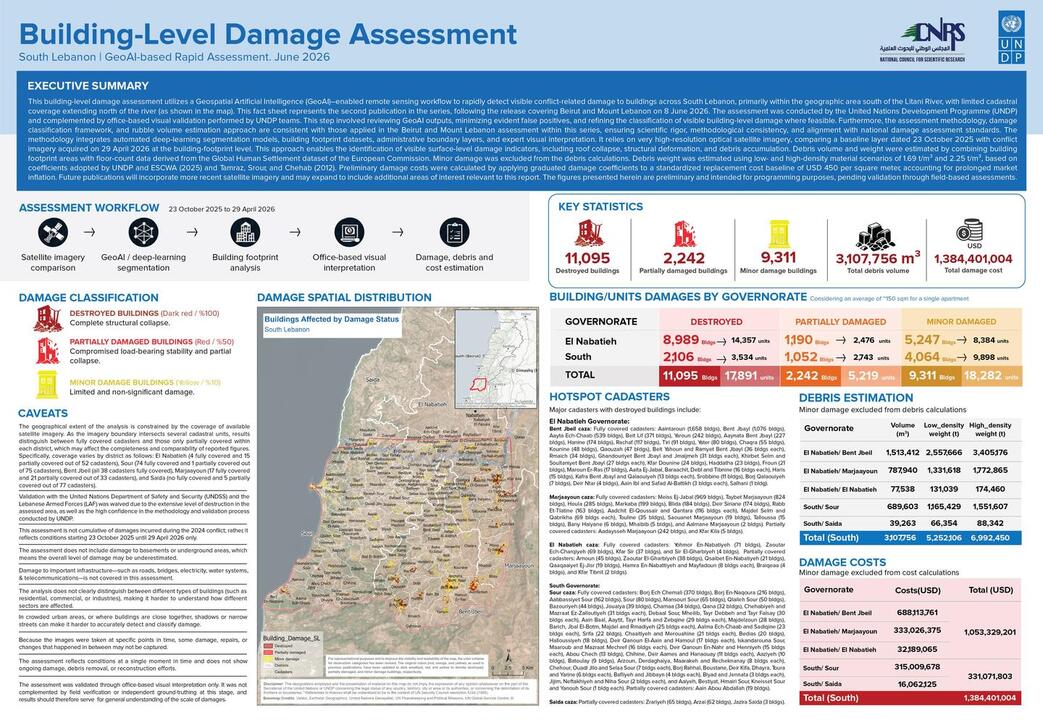
NNA - The United Nations Development Programme (UNDP), in coordination with the Lebanese National Council for Scientific Research (CNRS-L), has announced the results of a rapid building-level damage assessment across South Lebanon. The assessment covers areas south of the Litani River, including Bent Jbeil, Marjaayoun, El Nabatieh, Tyre, and Saida, and follows the recent release for Beirut and Mount Lebanon.
Findings indicate that direct damage to buildings in South Lebanon is estimated at USD 1.38 billion, with an associated debris volume of approximately 3.1 million cubic metres. In total, 11,095 buildings were completely destroyed, impacting 17,891 housing units, while 2,242 buildings sustained partial damage (affecting 5,219 housing units) and 9,311 buildings incurred minor damage (affecting 18,282 housing units). The most severely affected cadasters in terms of total building destruction include Aitaroun (1,658 buildings) and Bent Jbeil (1,076 buildings) in Bent Jbeil caza; Meiss Ej Jabal (969 buildings) and Taybeh Marjaayoun (824 buildings) in Marjaayoun caza; followed by Borj Ech Chemali (370 buildings) and En-Naqoura (216 buildings) in Sour caza.
The assessment used a Geospatial Artificial Intelligence (GeoAI) workflow*, complemented by office-based visual validation only and is not complemented by a ground-truthing exercise. High-resolution satellite imagery from 29 April 2026 was compared with a baseline from 23 October 2025, allowing identification of visible conflict related damage such as roof collapse, structural deformation, and debris accumulation at the building-footprint level. Debris volumes and damage costs were calculated using building footprints, floor counts, and standardized replacement costs, consistent with UNDP methodology and previous assessments.
While the assessment provides a robust overview of the scale of damage, it does not include basements, underground structures, or damage to critical infrastructure such as roads, bridges, electricity, water, and telecommunications. Figures reflect conditions as of 29 April 2026 and do not account for ongoing recovery or reconstruction efforts.