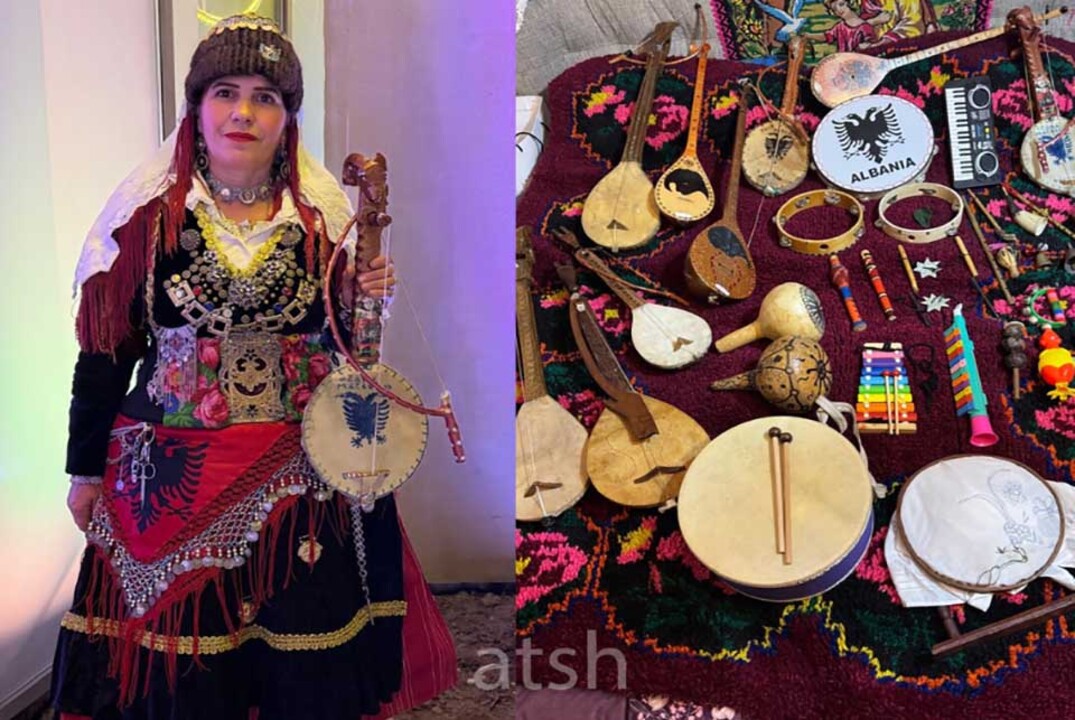
TIRANA, Jan 10 /ATA/ In Northern Albania, the lute is the soul of the land, with melodies that convey stories faster than anyone can journey along its roads.
In earlier times, the highland rhapsodes were plentiful. They played the lute, singing tales of heroes as well as the everyday lives of people from their regions, thus preserving knowledge and the art of musical performance. The family of the legendary Gjok Nonaj—who performed at the remarkable age of 105 at the Gjirokastër Folklore Festival—has also produced the female lutenist Lumturije Nonaj.
This art, now recognised by UNESCO, was mastered by Lumturije, Gjok Nonaj’s granddaughter, from a young age.
The Albanian lutenist was born in Lezhë but is originally from Shkrel in Malësia e Madhe. The granddaughter of the legendary rhapsode Gjok Nonaj (1910–2017) says that the lute’s heritage now lives on through the grandchildren who preserve his legacy.
“I was almost born a lutenist, as my family has been known for generations as a family of lute players. I started playing the çifteli (traditional two-stringed instrument) at the age of five, and began playing the lute when I was twelve,” says Lumturije, who is saddened by the fact that this skill has been passed down to only a few.
In her family, four of her brothers—Nikolla, Luigji, Gjeta, and Gjovalin—are also lutenists, and Lumturije has begun teaching the instrument to her husband, Gjovalin.
She notes that passing on the skill of playing the instrument is not particularly difficult.
Lumturije aims not only to play the instrument but also to teach it to young people. Since the lute’s recognition by UNESCO, interest in learning about it has grown. She remains hopeful that Albania will continue to produce both male and female lutenists.
Lumturije Nonaj plays the lute, performing traditional heroic songs as well as her own compositions about love, Malësia e Madhe, and migratory birds, preserving a cultural heritage now recognised by UNESCO.
Lumturije Nonaj says she now feels proud that the Albanian lute (lahutë) is recognised worldwide as part of UNESCO’s heritage. “This is a victory not only for our traditional music, but for Albanian culture as a whole. The fact that the world values it gives us a special strength and emotion to preserve and carry forward this sacred art of our ancestors,” Lumturije states.
/sm/