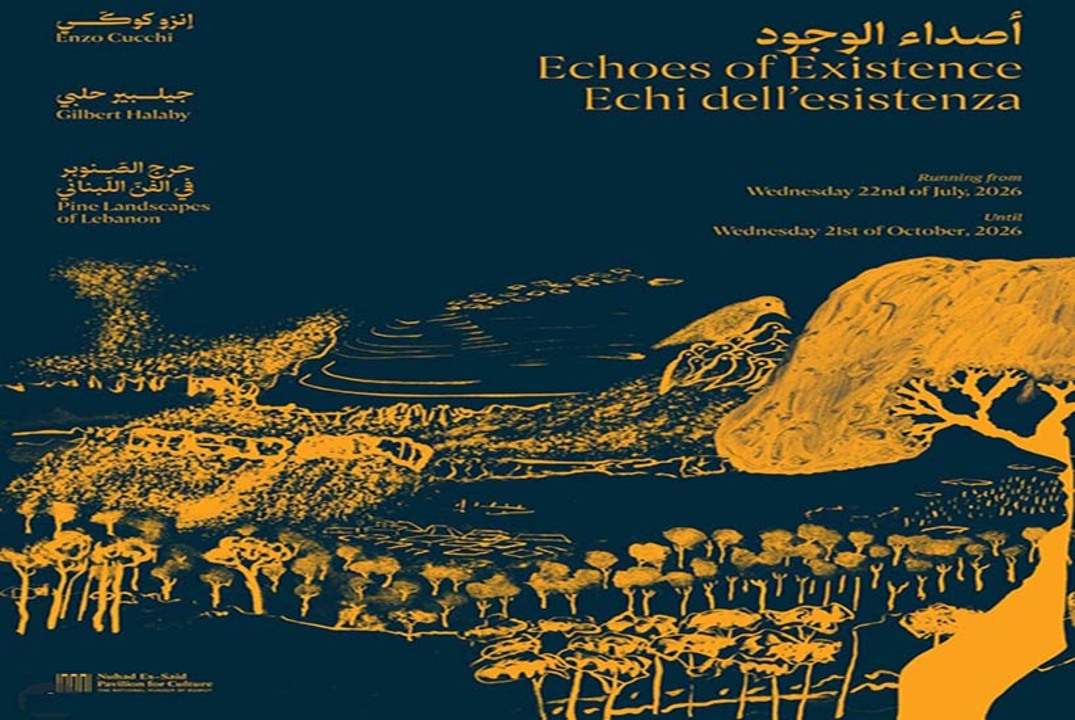
NNA - Under the patronage of the Ministry of Culture, the exhibition Echoes of Existence, initiated by the Embassy of Italy in Lebanon and curated by Muriel Asmar, officially opened at the Nuhad Es-Said Pavilion for Culturewithin the National Museum of Beirut, in the presence of H.E. Mr. Fabrizio Marcelli, Ambassador of Italy to Lebanon, members of the Nuhad Es-Said Pavilion for Culture Committee, artist Gilbert Halaby, cultural figures, and members of the artistic community, celebrating a remarkable artistic dialogue between Italy and Lebanon.
Echoes of Existence is a major exhibition centered around the pine tree as a shared symbol deeply rooted in both Italy and Lebanon, bringing together artists Enzo Cucchi and Gilbert Halaby, and an array of Lebanese modern masters. Enzo Cucchi is one of Italy’s most celebrated artists, and Gilbert Halaby is a Lebanese-Italian artist who has lived in Rome for the past twenty-three years. Also, this exhibition highlights the broader artistic landscapes of Lebanese artists and includes an environmental dimension through the contribution of the Carabinieri Biodiversity and Forestry Units.
During the opening, H.E. Mr. Fabrizio Marcelli declared:"Echoes of Existence brings together artists, institutions and landscapes that belong to a shared Mediterranean space. Through the symbol of the pine tree, common to Italy and Lebanon, the exhibition connects cultural memory with environmental responsibility and serves as a platform to strengthen a partnership dedicated to the protection of our shared Mediterranean natural and cultural heritage."
The Committee of the Nuhad Es-Said Pavilion for Culture stated: "How do chance encounters become lasting dialogues? How can art continue to safeguard memory, belonging, and care in a world defined by rupture and ecological fragility? At the heart of Echoes of Existence, the pine-silvered by Mediterranean winds-answers these questions. Through serendipity, artistic affinity, and shared landscapes, Italian and Lebanese artists, by paint and vision, have transformed the tree into a shared cultural language, revealing both nations’ profound reverence for nature, their enduring bonds, and the quiet strength of beauty."
Curator Muriel Asmar noted: "At a time when cultural dialogue is more important than ever, Echoes of Existence reaffirms the power of art to build bridges across cultures, histories, and geographies."
At the heart of the exhibition stands the pine tree, a shared emblem of Italy and Lebanon, transformed by both artists, Enzo Cucchi and Gilbert Halaby, into a symbol of strength, continuity, and cultural memory. Silent witness to centuries of history, the pine becomes the exhibition’s central protagonist, echoing existence across landscapes and generations. Yet today, this emblematic tree faces environmental threats, underscoring the urgency of preserving both natural and cultural heritage.
The exhibition unfolds across three levels of the Nuhad Es-Said Pavilion for Culture:
The upper level opens with a wall installation by Enzo Cucchi composed of sketches, drawings, and fragments of works forming a visual manuscript of symbols and gestures, accompanied by two sculptures that frame the installation.
Facing this ensemble stands Halaby’s monumental painting Sannine, a vast meditative canvas painted in Rome at Palazzo Nardini. Near it, a three-meter-diameter tondo rests directly on the floor, functioning like a reflective surface where pine trees appear to stand and breathe, inviting the viewer into a contemplative encounter between sky, landscape, and body.
The -1 level presents a contemplative installation where Halaby’s forest of pine trees unfolds across paintings of varying dimensions installed side by side, forming a rhythmic landscape of memory and gesture.
This visual language finds resonance in Enzo Cucchi’s sketches, where the pine appears through rapid and almost archaic marks, suggesting the tree as an elemental sign moving fluidly between drawing and painting.
Along these same walls, a historical dialogue unfolds through works by Lebanese modern masters such as Omar Onsi, Moustafa Farroukh, César Gemayel, and Aref El Rayess, who also depicted the pine tree in their landscapes. Their presence reveals a genealogy of the motif within Lebanese art history, creating a bridge between modern and contemporary interpretations of landscape, identity, and memory. This section, developed with research by Saleh Barakat, expands the dialogue across generations, highlighting how the pine tree has persisted as a poetic and national symbol within Lebanese visual culture.
On the -2 level, a dedicated space presented in collaboration with the Carabinieri Biodiversity and Forestry Units introduces an environmental dimension to the exhibition. Ten wooden sculptures, each carved from a different species of tree found in Italy, stand as sentinels of living heritage.
Accompanied by educational panels, this installation highlights the Carabinieri’s mission in protecting forests, biodiversity, and natural ecosystems, emphasizing the urgency of safeguarding our shared environmental heritage.
The exhibition is further accompanied by a special publication package bringing together three books dedicated to the artistic and historical dialogue at the core of Echoes of Existence: a book with artworks by Enzo Cucchi, a book with artworks by Gilbert Halaby, and a third book, Pine Landscapes of Lebanon, a Selection of Modern Lebanese Art by Saleh Barakat. The books are published under the editorial direction of Marie Tomb.
Together, these books extend the exhibition beyond the Pavilion space, offering deeper insight into the artistic, cultural, and historical narratives at the heart of the exhibition.