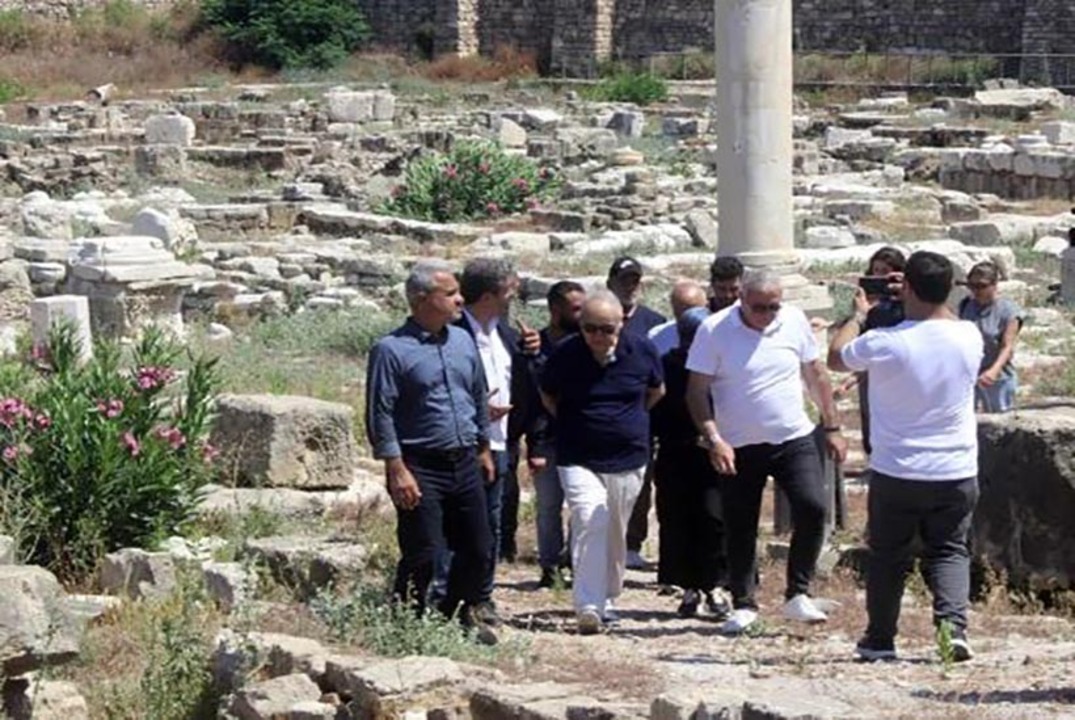
NNA - Minister of Culture Dr. Ghassan Salamé, the first minister in the government to visit southern Lebanon following the Israeli aggression, toured the city of Tyre to inspect the damage inflicted on its archaeological sites and assess firsthand the extent of the attacks targeting the city's historical and cultural heritage. He was accompanied by Director General of Antiquities Eng. Sarkis Khoury and a number of officials from the Directorate General of Antiquities.
The minister and his delegation were welcomed by Members of Parliament Ali Khreis, Inaya Ezzeddine, and Hassan Jishi, the President of the Union of Municipalities of the Tyre District, Eng. Hassan Dbouk, and Deputy Mayor of Tyre Alwan Sharafeddine.
The tour began at the Al-Bass archaeological site, where Minister Salamé reviewed the damage caused by the Israeli attacks.
At the Tyre archaeological site, Minister Salameh stressed that his visit stemmed from a "national and moral duty to assess the scale of the damage inflicted on the archaeological heritage as a result of the Israeli aggression and to document this attack on a site of universal historical and human value, in violation of all international laws, conventions, and protocols protecting cultural heritage."
He noted that he had held a series of discussions with culture ministers from several countries to urge them to assume their responsibilities regarding what had occurred in southern Lebanon, emphasizing that protecting archaeological heritage is a shared international responsibility, particularly at the historic sites of Tyre, Chamaa, Beaufort (Al-Shaqif), Shaqra, and Tebnine.
Salameh said: "It is true that UNESCO has no army to protect heritage sites, but through diplomatic, legal, and media channels we can confront these attacks and bring them before international public opinion."
He announced that he has maintained continuous contact with the Director-General of UNESCO, which contributed to the convening of an extraordinary meeting of the World Heritage Committee. The Committee unanimously approved the expansion of the scope of protected sites, underscoring the international community's concern for Lebanon's endangered cultural heritage.
The minister revealed two key decisions adopted by the Ministry of Culture. The first is to seek the inscription of the archaeological sites of Tyre on the list of permanently endangered sites, given the risk of further attacks, thereby placing additional responsibilities on the international community for their protection. The second is to work toward securing internationally protected status for the historic castles of Jabal Amel in Shaqra, Chamaa, Tebnine, and Beaufort (Al-Shaqif).
He stressed the need to continue efforts to protect the antiquities of Tyre, the city itself, and all the villages of Jabal Amel—"their people and their stones alike"—from repeated Israeli attacks targeting both people and heritage.
The minister and the accompanying delegation then toured several buildings and facilities in the city of Tyre that had been targeted during the Israeli attacks, reviewing the scale of the destruction and damage.
For her part, MP Inaya Ezzeddine welcomed the minister and his delegation, pointing to the extensive damage sustained by Tyre's archaeological sites and infrastructure. She affirmed that the city is the "Pearl of the Mediterranean" because of its rich civilizational, cultural, and human heritage.
MP Ali Khreis stressed that all Lebanese state institutions should declare a comprehensive national mobilization to support southern Lebanon, strengthen its resilience, and rebuild what had been destroyed by the Israeli attacks. He also emphasized the importance of official visits to the southern regions to witness firsthand the suffering of their residents and their needs.
MP Hassan Jishi praised the visit, saying it helps expose the "barbaric Israeli practices" against cultural, archaeological, and humanitarian sites in southern Lebanon.
The President of the Union of Municipalities of the Tyre District, Eng. Hassan Dbouk, described the visit as a positive step and a clear message to the international community condemning the Israeli attacks on cultural centers, archaeological sites, and heritage landmarks. He reaffirmed the commitment to preserving southern Lebanon's cultural identity and safeguarding its historical legacy for future generations.
Minister Salameh also toured the old quarters and streets of Tyre that had been affected by the Israeli attacks.
He visited the old city of Tyre, including the Maronite Archdiocese of Tyre, where he met with Bishop Charbel Abdallah.
The Minister of Culture concluded his visit with a stop at the Tyre Municipality, where he was received by the Mayor, Eng. Hassan Dbouk