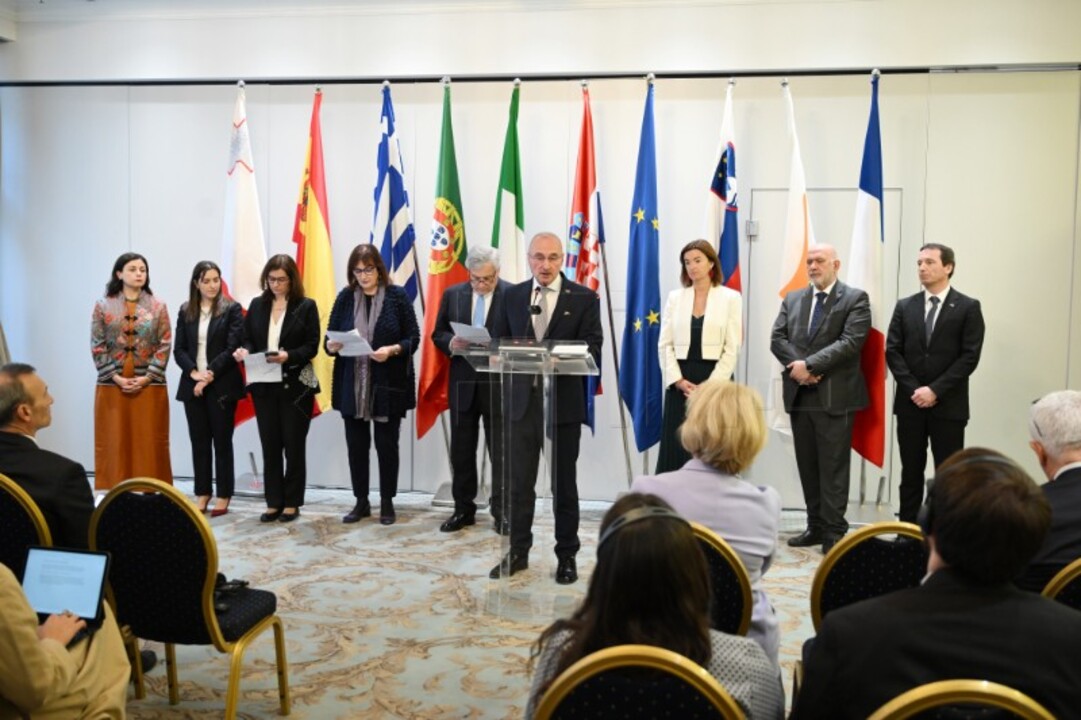
ZAGREB, 10 April (Hina) - Foreign ministers from the EU MED9 group met informally in Split on Thursday, hosted by Croatia’s Foreign Ministry, to strengthen political dialogue and coordinate responses to security challenges in the Mediterranean in line with the goals of the Pact for the Mediterranean.
The MED9 group brings together Mediterranean EU member states. The meeting took place against the backdrop of the current security situation in the Middle East and its impact on the region, including risks to maritime security, disruptions to energy flows and potential migration pressures.
Ministers exchanged views on strengthening a coordinated and comprehensive approach to Mediterranean security, with a focus on the resilience of energy supply routes, maritime safety and enhanced cooperation in addressing current challenges.
Croatian Foreign Minister Gordan Grlić Radman said global tensions, particularly in the Middle East, were the main reason for convening the meeting, adding that key topics included Mediterranean security, energy security and migration management.
He stressed the need to strengthen coordination and cooperation among countries, as well as engagement with southern neighbourhood partners. This is extremely important if we want, through unity and stronger infrastructure, to contribute to peace and a better understanding of the situation in the Middle East, he said.
On ongoing conflicts, he said there was agreement on the need to halt them. We are all concerned because civilian casualties are unacceptable. International humanitarian law must be respected, Grlić Radman said.
He announced further activities under Croatia’s MED9 presidency, including ministerial meetings and a summit in Split in October, with a focus on migration and energy. He highlighted Croatia’s role as an energy hub, citing its LNG terminal, the JANAF oil pipeline, and the development of renewable energy and transport infrastructure.
European Commissioner for the Mediterranean Dubravka Šuica said the Mediterranean is an increasingly complex and important region. The Mediterranean includes the Middle East and the Gulf countries and is a very broad and complex region, she said, adding that the EU aims to further connect countries in the area.
She announced plans for a Mediterranean action plan featuring key projects, including the creation of a network of universities. This will not be a new university, but a network of institutions across the Mediterranean that will enable young people to connect, she said.
On energy, she highlighted the potential of the southern Mediterranean for renewable energy development. Our goal is to produce affordable renewable energy in the south and import it into the European Union to reduce dependence on fossil fuels, she said.
She also addressed migration, stressing the need for preparedness. We must be ready - we are working on solutions for irregular migration, but also on ensuring legal and safe pathways, Šuica said.
Participants agreed on the need to strengthen a joint approach to Mediterranean security, including the resilience of energy systems, maritime route security and more effective management of migration challenges.