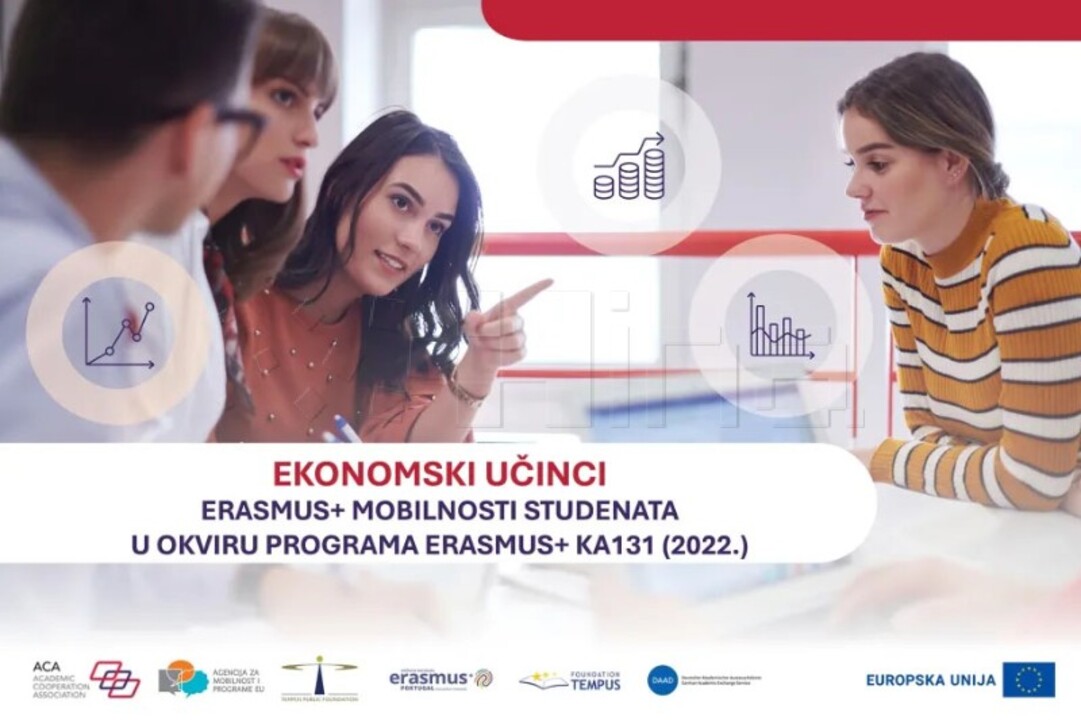
ZAGREB, 10 March (Hina) - Erasmus+ student mobility not only supports education and skills development but also has a measurable economic impact, with international students coming to Croatia through the programme generating millions of euros in additional economic activity.
This was shown by the study "Economic Impact of Erasmus+ Student Mobility: Insights from Croatia, Germany, Hungary, Portugal and Serbia", conducted by the Academic Cooperation Association (ACA) in cooperation with national Erasmus+ agencies.
The analysis covers student mobility financed under the 2022 Erasmus+ call, including study exchanges and student traineeships carried out between the 2021/2022 and 2023/2024 academic years. It examines the short-term economic effects of student spending, while longer-term benefits such as skills development and international networking were not included. The study found a positive economic impact in all five countries analysed.
Under the programme, 3,187 students from 31 countries came to Croatia, with 83% staying longer than two months, accounting for the largest share of the economic impact. Most students came from France, Spain and Germany, and nearly half of all exchanges took place in Zagreb, with Split and Rijeka also among popular destinations.
The study estimates that incoming Erasmus+ students spend around €7 million in Croatia. They received €5.58 million in grants, while an additional €1.44 million came from personal or family funds, bringing extra private spending into the Croatian economy.
Overall, the mobility generated an estimated €6.86 million in gross value added, economic activity equivalent to around 200 jobs, and €3.08 million in public revenue.
At the same time, 2,604 Croatian students took part in Erasmus+ mobility in 31 countries, but despite these outbound exchanges the net economic impact for Croatia remains positive.
"This research shows that student mobility is not only an investment in education but also a concrete contribution to the economy. Incoming students generate demand, support employment and create fiscal revenues," said Antonija Gladović, director of Croatia's Agency for Mobility and EU Programmes, which coordinated the study with partner institutions in Germany, Hungary, Portugal and Serbia.